Humanity: How Jimmy Carter Lost an Election and Transformed the Post-Presidency (Kindle Single) by Jordan Michael Smith
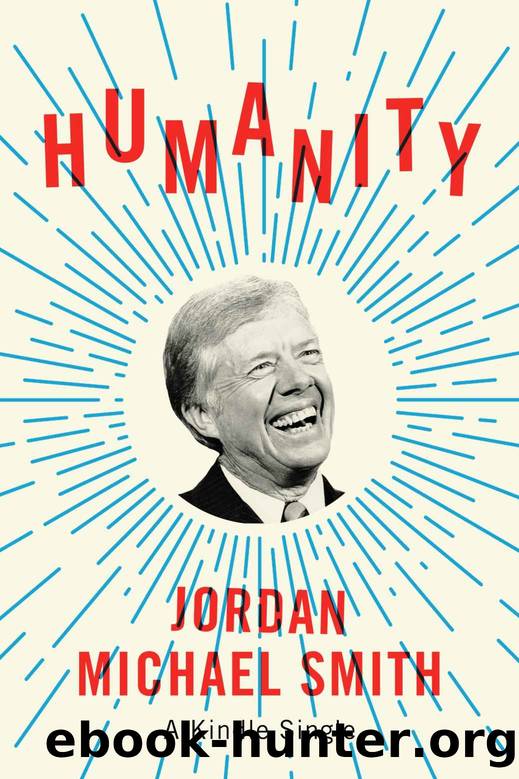
Author:Jordan Michael Smith [Smith, Jordan Michael]
Language: eng
Format: azw3
Published: 2016-07-09T00:00:00+00:00
WHEN CARTER RETURNED to Washington, he was hailed as a hero. Even his Republican critics praised his courage and fairness. The conservative Washington Times complimented his bravery. And all of a sudden, all of Carterâs good works, all he had done since he had left Washington as a national disgrace more than eight years earlier, became noticed and admired inside the Beltway. âIf scholars get around to evaluating presidential retirements, Carterâs will rank at the top,â declared the Washington Post. âIn debt when he left the White House, eschewing a lecture agent and accepting only an occasional paid speech, he conducts himself as if his presidency was a priceless heirloom: sacred to him because it is sacred to the people.â
âAs recently as last yearâs election, Mr. Carterâs presidency was used as a foil by Mr. Bush and other Republican politicians,â the New York Times observed. â[But now] Mr. Carter is increasingly involved with programs dealing with world hunger, human rights and conflict resolution.â A different piece in the Times noted, âJimmy Carter the man is emerging as the best former president.â
His return to Panama was recognized as a masterpiece of guerrilla diplomacy. Declared the Atlanta Journal-Constitution: âMr. Carter, as he has been demonstrating quietly for years and has just demonstrated spectacularly in Panama, is the class of the fieldâthe most imaginative, the most exemplary, and the most useful to his country; in short, the most presidential of the ex-presidents.â Time joined in, calling him âour best ex-president.â Yet another Washington Post article said he was âexperiencing a kind of renaissance.â
Although his confrontation with Noriega didnât stop the fraudulent electionâPresident Bush launched a war to remove the Panamanian strongman, and Carter publicly opposed it, to Bushâs annoyanceâhis efforts to establish democracy in a troubled nation were lauded around the world.
As gushing as the praise was, none of it could encapsulate the magnitude of Carterâs actions as ex-president, because none of his many newfound admirers could foresee the ongoing importance he would have on the world stage.
Carterâs efforts in Panama were followed with similar diplomatic adventures in Nicaragua, Haiti, and North Korea. The same pattern repeated itself in all cases: Carter was tapped to do a job nobody else could do, and with his stubbornness and freelancing he often irritated the very presidents who had called upon him.
Sometimes this determination to achieve peace has gone too far. He flirted with treason in 1990 when he wrote a letter to members of the U.N. Security Council asking them to oppose President George H.W. Bushâs moves toward war with Iraq. When the New York Times reported on the correspondence, even Carterâs best friends criticized him. But he refused to apologize, saying only that â[it] was inappropriate perhaps.â In fact, the Logan Act prohibits any U.S. citizenâeven a former presidentâfrom engaging in private diplomacy with foreign governments.
The flip side of this narrow-mindedness is an unceasing quest to improve international health. His mission to defeat Guinea worm in Africa and Asia has proved so successful that
Download
This site does not store any files on its server. We only index and link to content provided by other sites. Please contact the content providers to delete copyright contents if any and email us, we'll remove relevant links or contents immediately.
| Africa | Americas |
| Arctic & Antarctica | Asia |
| Australia & Oceania | Europe |
| Middle East | Russia |
| United States | World |
| Ancient Civilizations | Military |
| Historical Study & Educational Resources |
The Dawn of Everything by David Graeber & David Wengrow(1707)
The Bomber Mafia by Malcolm Gladwell(1622)
Facing the Mountain by Daniel James Brown(1553)
Submerged Prehistory by Benjamin Jonathan; & Clive Bonsall & Catriona Pickard & Anders Fischer(1455)
Wandering in Strange Lands by Morgan Jerkins(1430)
Tip Top by Bill James(1416)
Driving While Brown: Sheriff Joe Arpaio Versus the Latino Resistance by Terry Greene Sterling & Jude Joffe-Block(1376)
Red Roulette : An Insider's Story of Wealth, Power, Corruption, and Vengeance in Today's China (9781982156176) by Shum Desmond(1359)
Evil Geniuses: The Unmaking of America: A Recent History by Kurt Andersen(1353)
The Way of Fire and Ice: The Living Tradition of Norse Paganism by Ryan Smith(1336)
American Kompromat by Craig Unger(1315)
F*cking History by The Captain(1304)
It Was All a Lie by Stuart Stevens;(1300)
American Dreams by Unknown(1286)
Treasure Islands: Tax Havens and the Men who Stole the World by Nicholas Shaxson(1273)
Evil Geniuses by Kurt Andersen(1257)
White House Inc. by Dan Alexander(1212)
The First Conspiracy by Brad Meltzer & Josh Mensch(1174)
The Fifteen Biggest Lies about the Economy: And Everything Else the Right Doesn't Want You to Know about Taxes, Jobs, and Corporate America by Joshua Holland(1126)
